Managed Messaging Intelligence
Complex Messaging. Clear Answers.
Collabovizion provides specialized messaging assessments, investigations, governance, and architecture across Microsoft 365, Exchange, Google Workspace, secure email gateways, DLP, and hybrid messaging environments.
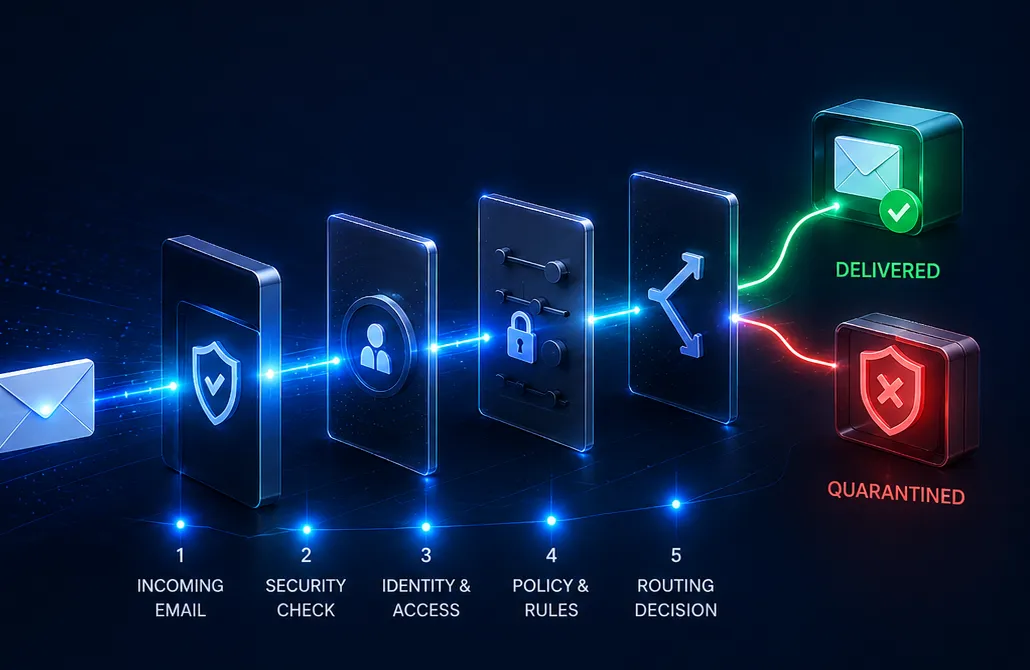
Messaging problems rarely live in one system.
Message state, gateway action, DLP, transport rules, and route decisions often span multiple systems — which is exactly where visibility breaks down.
- Who really has mailbox access?
- Why did this message take that route?
- What changed — and when?
One question. Many sources.
Identity
DelegationPrincipal
Message Flow
Routing hopRelay decision
DNS & Domain
SPFDMARC
Security Gateway
QuarantinePolicy match
Policy
Rule stateException
Delivery Evidence
TimestampHeader result
Header result — diverges from policy match
Services
Four ways we bring clarity to messaging.
Focused Engagements
Messaging Intelligence Assessment
Structured, read-oriented review of governance, configuration, exposure, authentication, routing, and operational gaps.
Learn more →Complex Messaging Investigation
Reconstruct difficult message paths across platforms, gateways, DLP, transport controls, and routing decisions.
Learn more →Ongoing Engagements
Managed Messaging Intelligence
Recurring oversight for complex environments: change intelligence, governance review, investigation, and advisory.
Learn more →Fractional Messaging Architect
Senior messaging architecture and engineering expertise without adding a full-time specialist.
Learn more →Free Diagnostic Tools
Messaging Diagnostic Toolkit
Nine focused diagnostic utilities. No account required.
Featured Diagnostics
Domain Email Trust Check
Evaluate domain-level email trust signals including SPF, DKIM, and DMARC alignment.
Open tool →Email Header Analyzer
Trace message hops, delays, authentication outcomes, and suspicious header patterns.
Open tool →Message Origin Analyzer
Correlate identity, routing, authentication and ARC evidence already in the headers.
Open tool →
Full Diagnostic Catalog
DNS Records Viewer
View and inspect DNS records relevant to email delivery.
Open tool →DMARC Policy Maturity
Evaluate DMARC posture from monitoring through enforcement.
Open tool →SPF Lookup / Flattening Risk
Analyze SPF records and assess DNS lookup flattening risk.
Open tool →DKIM Selector Checker
Validate DKIM selector DNS records and key configuration.
Open tool →MTA-STS / TLS-RPT Checker
Validate MTA-STS policy and TLS reporting DNS records.
Open tool →Domain Email Trust Check
Evaluate domain-level email trust signals including SPF, DKIM, and DMARC alignment.
Open tool →Email Header Analyzer
Trace message hops, delays, authentication outcomes, and suspicious header patterns.
Open tool →Message Origin Analyzer
Correlate identity, routing, authentication and ARC evidence already in the headers.
Open tool →IP Blocklist Check
Check whether an IP or host appears on selected common blocklists.
Open tool →
Who We Help
Organizations that need deeper visibility, governance, and intelligence across complex messaging environments.
Complexity — not company size — is what justifies specialist messaging expertise.
Hybrid
Cloud + on-premises
Multi-Domain
Multiple identities & namespaces
Cross-Platform
M365 · Google · Exchange · gateways
Regulated
Policy · audit · evidence
Central Core
Messaging Complexity
Capabilities
Messaging intelligence and governance across the systems that move, control, and expose email.
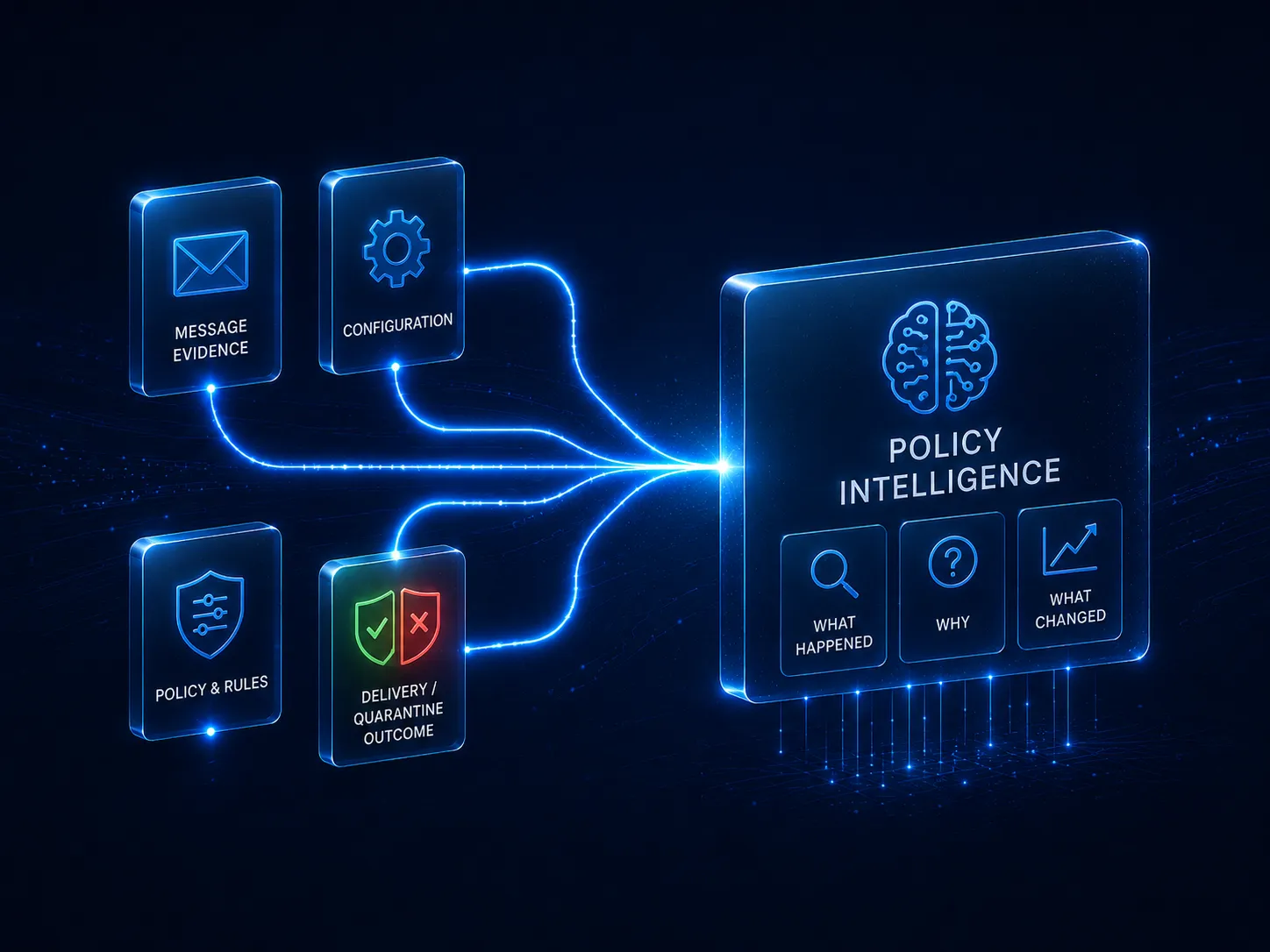
Configuration, identity, transport, security controls, and message evidence connect into one operational picture.
What Happened
Correlate messaging evidence to reconstruct the relevant message path and outcome.
Why Did It Happen
Connect configuration, policy, routing, and available evidence to explain the decision path.
What Changed
Compare relevant evidence and configuration context to identify meaningful differences.
The Next Step
Complex Messaging Environments Deserve Clear Answers.
If your messaging infrastructure spans multiple platforms, policies, and evidence sources — and the questions keep getting harder — we should talk.